Description
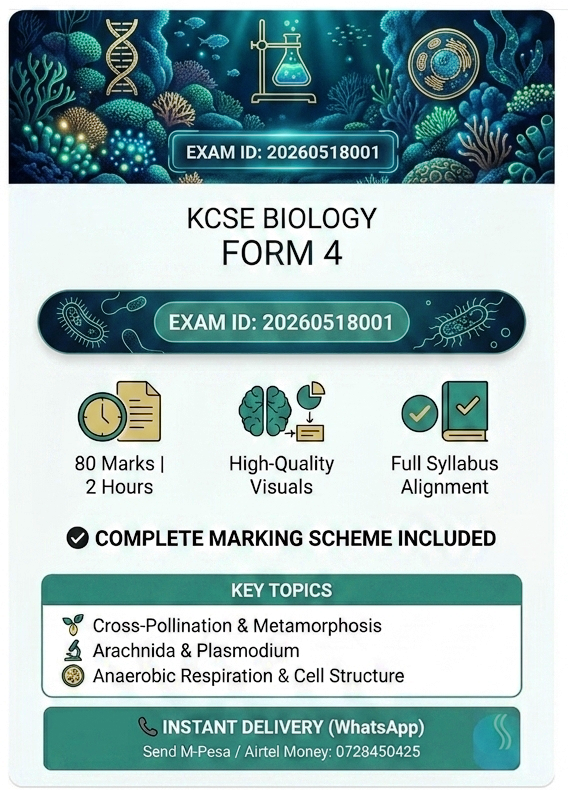
KCSE BIOLOGY FORM 4 COMPREHENSIVE EXAMINATION PAPER (WITH FULL MARKING SCHEME)
Exam ID: 20260518001_BIOLOGY_F4
Time: 2 Hours | Maximum Score: 80 Marks
High-Quality, Syllabus-Aligned KCSE Examination Resource
Prepare your Form 4 students for KCSE success with this comprehensive Biology Form 4 Examination Paper. Specifically engineered to meet rigorous KCSE standards, this resource covers all critical Form 4 Biology topics with a complete, ready-to-use marking scheme.
Perfect for:
Form 4 students preparing for KCSE final examinations
Teachers needing ready-to-administer end-of-term assessments
Revision classes and holiday tutoring programs
🌟 Key Product Features
| Feature | Description |
|---|---|
| Exam Format | Structured assessment with 26 questions covering entire Form 4 syllabus |
| Total Marks | 80 marks |
| Duration | Standard 2-hour examination setting |
| Marking Scheme | Complete official answers with grading criteria |
📚 Comprehensive Topic Coverage
| Topic Area | Specific Content |
|---|---|
| Plant Biology | Characteristics specific to plants, Cross-pollination mechanisms (Protandry, Protogyny, Self-sterility, Heterostyly) |
| Growth & Development | Complete vs Incomplete metamorphosis, Importance of moulting in insects |
| Classification | Arachnida class (spiders, scorpions, ticks, mites), Plasmodium kingdom (Protista) |
| Respiration | Anaerobic respiration end products in plants (Ethanol, CO₂, Energy), Lactic acid effects on heartbeat |
| Reproduction | Flower parts producing gametes (Ovary, Anther), Human sperm adaptations (Acrosome, Mitochondria, Tail) |
| Ecology | Ecology definition, Carrying capacity, Food web analysis |
| Cell Biology | Animal cell ultrastructure (Nuclear pore, Rough ER), Microscope parts functions |
| Physiology | Placenta functions, Nutrients absorbed without digestion (Water, Minerals, Vitamins) |
| Parasitism | Ascaris lumbricoides adaptations (Cuticle, Muscular pharynx, Anaerobic respiration) |
| Health | AIDS transmission routes (Sexual contact, Blood transfusion, Mother-to-child) |
| Genetics/Reproduction | Human reproductive structures (Fallopian tubes, Epididymis, Scrotal sac), Mitosis importance |
| Dispersal | Fruit and seed dispersal mechanisms (Explosive, Water, Wind, Animal) |
🔬 High-Quality Diagrams Included
Clear, exam-standard illustrations:
Generalized animal cell (electron microscope view) – Label parts A and B
Food web ecosystem analysis
Transverse section of ovary (Ovule W, Axile placentation)
Reproductive organs of plant and animal (Figures 1 & 2)
Plant habitat identification diagram
🧮 Practical Calculations Included
Magnification Problem:
A student observing a leg of an insect under a hand lens made a drawing of the leg whose length was 4 cm with a magnification of ×2. What was the actual length of the leg?
Answer: 2 cm (Formula: Actual length = Drawing length ÷ Magnification)
📊 Comparison Tables Included
| Complete Metamorphosis | Incomplete Metamorphosis |
|---|---|
| Eggs hatch into larvae (very different from adult) | Eggs hatch into nymphs (resemble the adult) |
| Four stages: egg → larva → pupa → adult | Three stages: egg → nymph → adult |
📘 Complete Marking Scheme Included!
No more guessing or tedious hours drafting answers.
This package comes complete with an Official Marking Scheme featuring:
| Feature | Benefit |
|---|---|
| Exact Answers | Word-for-word correct responses for all 26 questions |
| Step-by-Step Solutions | Magnification calculation breakdown |
| Comparison Tables | Pre-formatted metamorphosis differences |
| Diagram Labels | Correct identification of A=Nuclear pore, B=Rough ER, W=Ovule |
| Essay Rubrics | Detailed marking for descriptive questions |
📋 Sample Questions from the Paper
Section A (Short Answer):
State two characteristics that are specific to plants. (2 mks)
Name three mechanisms that ensure cross pollination takes place in flowering plants. (3 mks)
State two differences between complete and incomplete metamorphosis. (2 mks)
State the importance of moulting to an insect. (2 mks)
Diagram-Based Questions:
Name the parts labelled A and B in the animal cell diagram
Identify the structure labelled W and the type of placentation
From the food web: Identify the shortest food chain and organisms with highest number of predators/biomass
Applied Knowledge:
How is the human sperm cell structurally adapted? (2 mks)
State three ways roundworm (Ascaris lumbricoides) is adapted to its parasitic way of life. (3 mks)
State two ways by which AIDS virus is transmitted. (2 mks)
💳 How to Purchase
Getting your copy is quick and convenient via mobile money.
| Payment Method | Number |
|---|---|
| Safaricom M-Pesa | Send money or use Pochi la Biashara to 0728450425 |
| Airtel Money | Send money to 0738619279 |
📥 Instant Delivery via WhatsApp
Once your payment is complete, follow these simple steps:
Copy this Exam ID:
20260518001_BIOLOGY_F4Send the Exam ID via WhatsApp to either payment number (0728450425 or 0738619279)
Receive instantly — Your complete examination paper and marking scheme will be sent directly to your chat!
Format: Instantly downloadable PDF file, fully structured with official spaces for student credentials and examiner score sheets.
🎯 Why Choose This Resource?
| For Students | For Teachers |
|---|---|
| ✓ Self-assess with authentic KCSE-style questions | ✓ Save hours of lesson prep time |
| ✓ Learn correct marking scheme answers | ✓ Ready-to-use end-of-term exam |
| ✓ Practice magnification calculations | ✓ Complete grading rubric included |
| ✓ Master diagram identification | ✓ Perfect for revision classes |
| ✓ Understand parasitic adaptations | ✓ Covers entire Form 4 syllabus |
📌 Product Summary
| Detail | Information |
|---|---|
| Product Name | KCSE Biology Form 4 Comprehensive Examination Paper |
| Exam ID | 20260518001_BIOLOGY_F4 |
| Format | PDF (Instant Download) |
| Questions | 26 questions |
| Marks | 80 marks |
| Duration | 2 hours |
| Pages | 13 pages (Questions + Full Marking Scheme) |
| Price | KSh 50.00 |
| Delivery | Instant via WhatsApp |
Boost KCSE performance and save valuable preparation time with this ultimate Biology Form 4 examination companion!


Reviews
There are no reviews yet.